Navigating the program, however, can feel overwhelming. Many St. Louis homeowners do not realize that they are paying into this safety net every single year through their real estate property tax bills. Even worse, many property owners void their coverage entirely by executing unapproved emergency repairs before following mandatory county inspection protocols.
At Koo Plumbing, we connect local residents with trusted St. Louis plumbers who inspect laterals, diagnose collapsed pipes, and pull proper county and municipal permits every day. This complete coverage guide breaks down everything you need to know about eligibility, repair caps, and the step-by-step claims process.
What Is a Sewer Lateral and Who Owns It?
Your sewer lateral is the underground pipe that carries household wastewater and sewage away from your plumbing fixtures out to the public municipal sewer main (operated by the Metropolitan St. Louis Sewer District, or MSD).
A common misconception among homeowners is that MSD owns all underground sewer infrastructure up to the home's exterior wall. In reality, the homeowner is legally responsible for the entire length of the private lateral pipe—starting from the exterior foundation wall of the home and extending all the way out to the physical connection point at the street sewer main.
Because these underground pipes run beneath private lawns, mature trees, driveways, sidewalks, and municipal streets, replacing a collapsed line can easily cost between $4,000 and $15,000. That is precisely why the St. Louis County Sewer Lateral Repair Program was established.
The program is funded by a nominal annual fee (typically $28.00 per year) assessed directly on your St. Louis County real estate property tax bill. If your property taxes are paid up to date, you have actively contributed to this program and are entitled to apply for coverage when a qualifying structural failure strikes.
Unincorporated County vs. Incorporated Municipalities
One of the most critical aspects of St. Louis County's program is jurisdictional authority. St. Louis County is divided between unincorporated territory and over 80 incorporated municipalities (such as Florissant, Chesterfield, Ballwin, Kirkwood, Creve Coeur, Webster Groves, and Hazelwood).
- Unincorporated St. Louis County: Administered directly by the St. Louis County Department of Transportation and Public Works. The county manages the process from start to finish, contracts directly with pre-approved licensed contractors, and covers 100% of approved repair expenses with $0 deductible and $0 application fee.
- Contracting Municipalities: Some smaller cities contract directly with St. Louis County Public Works to administer the program on their behalf, adopting the county's identical zero-deductible model.
- Independent Municipal Programs: Many larger cities within St. Louis County manage their own independent sewer lateral programs funded by their local tax assessments. These programs often feature maximum coverage caps (commonly $2,500 to $7,500), modest deductibles ($100 to $300), copays (such as 15% or 20%), or require the homeowner to submit multiple itemized contractor estimates.
Coverage Comparison: Unincorporated County vs. Cities
To help you understand what financial assistance to anticipate, here is how the St. Louis County program compares across different jurisdictional models:
| Jurisdiction | Coverage Cap | Deductible / Copay | Contractor Selection |
|---|---|---|---|
| Unincorporated St. Louis County | 100% Approved Cost (No Cap) | $0 Deductible | County dispatches pre-qualified contractor |
| Contracting Cities (e.g. Fenton, Bel-Nor) | 100% Approved Cost | $0 Deductible | Administered via St. Louis County DPW |
| Independent City Programs (e.g. Ballwin, Florissant) | $2,500 - $7,500 Max Cap | $100 - $300 or 15-20% Copay | Homeowner collects 2-3 competitive bids |
| City of St. Louis (Municipality) | $3,000 - $4,000 Cap | Subject to municipal fund balance | City Street/Sewer Division pre-approval |
What Does the Program Cover?
When an application is formally approved, the program covers the critical heavy-duty civil and mechanical tasks required to restore an uninterrupted drain flow:
- Structural Pipe Defects: Complete pipe collapses, missing wall sections, severe shear breaks, major joint dislocations, and large fractures in vitrified clay, cast iron, or older plastic laterals.
- Excavation & Replacement: Digging down to the defective line, removing broken piping, and replacing it with schedule 40 PVC or HDPE piping.
- Modern Trenchless Repairs: When conditions permit, approved trenchless solutions such as sewer line repair and replacement using Cured-In-Place Pipe (CIPP) lining or hydraulic pipe bursting.
- Public Right-of-Way Work: Excavation within the street, alley, or easement, including traffic control permits and street plates.
- Site Backfill & Restoration: Compacting trenches with crushed rock/gravel, leveling disturbed soil, reseeding grass or laying sod, and pouring replacement concrete for damaged sidewalks and street pavement.
What Is NOT Covered Under the Program?
It is equally crucial to understand the limitations of the program so you are not caught off guard by unexpected out-of-pocket expenses:
- Interior Plumbing: The program strictly begins on the exterior side of the foundation wall (usually 12 to 24 inches outside). Any sewer or drain piping under your basement concrete slab, inside crawlspaces, or within walls is excluded. For internal slab leaks or under-slab pipe issues, homeowners need dedicated leak detection and slab leak repair.
- Routine Clogs and Tree Root Maintenance: Tree root growth, paper blockages, or grease accumulation without an underlying structural pipe failure do not qualify. Clearing routine clogs is standard homeowner maintenance.
- Initial Cabling & Camera Fees: The diagnostic expense to snake and video-scope your line before filing the claim is usually paid upfront by the homeowner. (Some municipalities may reimburse a portion of this if a structural collapse is verified).
- Repairs Executed Without Pre-Approval: If you panic during an emergency and pay a contractor to dig up your yard and replace the pipe before the county or city inspects and authorizes the job, your claim will almost certainly be denied.
- Auxiliary Drainage Systems: Sump pump discharge lines, French drains, downspout conductor pipes, and septic tanks are completely excluded. If you are experiencing groundwater backup in the basement, explore our sump pump installation and repair options.
Eligibility Requirements for Property Owners
To qualify for the St. Louis County Sewer Lateral Program, your property must satisfy four essential conditions:
- Residential Property Type: The building must be a residential structure containing six (6) or fewer dwelling units (e.g., single-family homes, duplexes, triplexes, or fourplexes). Commercial properties, mixed-use buildings, and large apartment complexes are ineligible.
- Up-to-Date Property Taxes: The applicant must provide verification that St. Louis County real estate taxes are completely paid with no outstanding liens or delinquent penalties.
- Documented Structural Failure: The line must exhibit structural failure (collapse, offset, crushed pipe) that prevents the lateral from functioning, confirmed via video inspection.
- Applicant Is Property Owner: Tenants cannot apply on behalf of landlords. The deeded homeowner or their authorized legal agent must execute the application.
The 5-Step Claim Process: How to Apply & Get Approved
Filing a successful sewer lateral claim requires following a strict sequence of steps. Deviating from this order can delay your approval or disqualify your repair entirely.
Step 1: Emergency Cabling & Snaking
When your drains back up, your first call should be to a licensed drain layer for a mechanical cable clearing. You must have a professional attempt to clear the line. If the cabling machine hits a solid structural blockage or collapses back on itself, the plumber will note that the lateral cannot be cleared due to a mechanical impediment.
Step 2: High-Definition Sewer Camera Video Scope
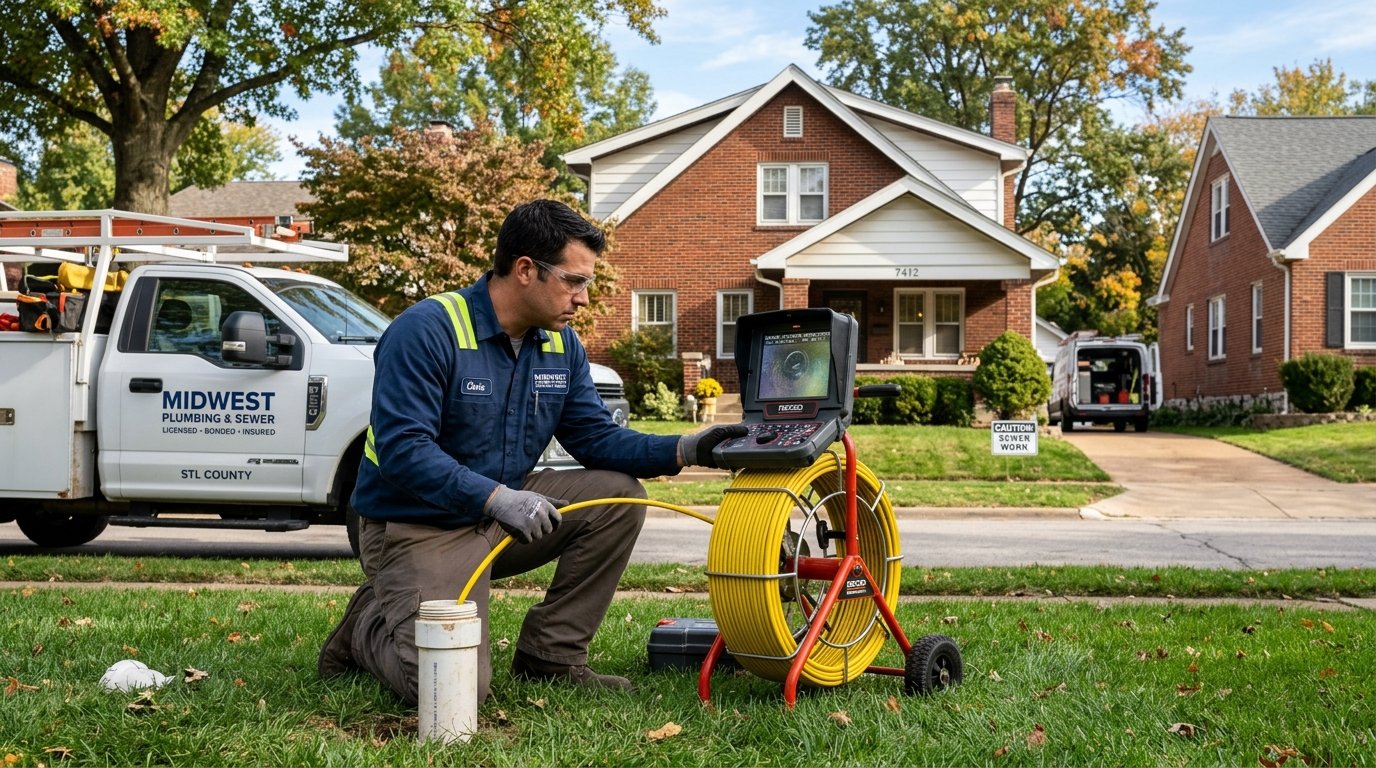
Next, the plumber feeds a fiber-optic camera down the lateral cleanout. To satisfy county requirements, the camera inspection must record high-resolution footage showing the exact footage distance from the cleanout to the defect, clear audio narration of pipe conditions, and the street address. Schedule this through our drain cleaning and rooter service professionals.
Step 3: Confirm Your Local Jurisdiction
Check your St. Louis County property tax bill or look up your parcel on the St. Louis County Revenue portal. Confirm whether your address is in unincorporated county or within an incorporated municipality. If you are within a municipality (such as Maryland Heights or Florissant), download their specific municipal claim form; if unincorporated, use the St. Louis County DPW portal.
Step 4: Submit Your Official Application Packet
Assemble and submit your documentation package: the completed application form, proof of paid real estate taxes, the itemized plumber diagnostic receipt, and the video inspection file (via USB flash drive, digital cloud link, or DVD). In municipalities that require multiple estimates, attach the required 2 or 3 licensed contractor bids.
Step 5: County Field Review & Repair Authorization
A county or city inspector will review the video footage and conduct an on-site field verification to confirm the location of the break. Once approved, the county will assign their contracted drain layer (for unincorporated areas) or issue you an official Notice to Proceed to hire your selected bonded contractor.
Warning Signs Your Lateral Is Failing
Sewer pipes buried 6 to 12 feet underground rarely give advance warning until they reach critical failure. However, St. Louis homeowners who spot these warning signs early can file their claim before catastrophic raw sewage floods their basement floor:
- Simultaneous Slow Drains: Multiple fixtures—such as your basement laundry drain, first-floor toilet, and kitchen sink—all emptying sluggishly at the same time.
- Gurgling Fixtures: Air bubbling or gurgling upward through toilet bowls when a washing machine drains or a bathtub empties.
- Persistent Sewer Gas Odors: Foul hydrogen sulfide ("rotten egg") odors lingering in the basement or around exterior foundation walls.
- Lush, Sunken Green Patches: A vibrant strip of dark green grass in your front yard that remains moist even during dry summer spells, or an indent in the turf indicating soil settling into a cracked pipe.
- Repeated Backups Within Months: Needing a drain cleaner more than once or twice a year is a definitive indicator of broken clay or cast iron pipe joints.
If you experience sudden indoor flooding or an uncontained sewage spill, shut off your main water valve immediately and reach out to our 24/7 emergency plumber network to stop the crisis while gathering evidence for your lateral claim.
Top 5 Mistakes That Can Invalidate Your Claim
Thousands of dollars in municipal benefits are forfeited every year across St. Louis County because of avoidable procedural missteps. Avoid these five critical traps:
- Authorizing excavation before county approval: Never sign a contract to start digging up your yard before the county or municipal inspector has issued an official written authorization. Work performed prior to approval is universally disqualified.
- Unusable camera video footage: Submitting a blurry, unreadable video without a clear digital distance counter or audio narration will result in your application being rejected or delayed by weeks.
- Delinquent property tax status: Even if only a penalty fee or prior year assessment is outstanding, county systems will automatically place your claim on hold. Verify zero balance before applying.
- Hiring an unlicensed contractor: Municipalities maintain strict lists of licensed Master Drainlayers who carry active St. Louis County licensing and bond minimums. Always verify your contractor's credentials.
- Ignoring potential whole-house plumbing stress: Severe lateral backups place backward hydrostatic pressure on household pipes. If you also suspect burst supply lines or structural pressure damage, be sure to have a technician evaluate burst pipe repair and home repiping requirements.
Frequently Asked Questions (FAQ)
Does standard homeowners insurance cover what the sewer lateral program doesn't?
Standard HO-3 homeowners insurance policies typically exclude underground service lines outside the home and water backups unless you have added specific endorsements: "Service Line Coverage" (which covers physical damage to utility pipes) and "Water Backup & Sump Overflow Coverage" (which helps pay for interior water extraction and drywall repair).
How long does the St. Louis County approval process take?
Under normal conditions, county or municipal review takes between 3 to 10 business days once a complete application packet and clear video are submitted. Emergency expedited reviews are available if active sewage is surfacing in the yard or backing up into living quarters.
Can I choose my own plumbing contractor?
In unincorporated St. Louis County, the county dispatches its own pre-selected contracted drainlayers who work under annual municipal master contracts. In most incorporated cities (like Florissant or Ballwin), you are free to select any licensed, bonded Master Plumber or Drainlayer from their approved registry.
What if my lateral runs underneath a tree, driveway, or street?
Approved programs cover the cost to excavate through driveways, sidewalks, and streets, as well as repaving the concrete/asphalt to municipal specifications. However, decorative private landscaping, flowerbeds, and sprinkler systems usually remain the homeowner's responsibility to restore.
What is the difference between MSD Project Clear and the Sewer Lateral Program?
MSD (Metropolitan St. Louis Sewer District) maintains the public collector mains, treatment plants, and large storm conduits. The Sewer Lateral Program is a county/city tax-funded program specifically designated to assist property owners with their private connection pipes connecting the house to MSD mains.